
What Is a Business Need, and Why Does It Matter for Business Growth?
There has to be a certain reason why a business is established in the first place. This can be a solution to a consumer’s problem, simplification of a process, provision of a valuable product, or catering to an unmet demand ignored by other organisations. The importance of knowing the underlying reason behind the establishment of a business is critical, since it is impossible to succeed sustainably by only considering the products being sold. It is necessary to know the needs of a business. That underlying reason is the purpose of a business, and it shapes every need that follows.
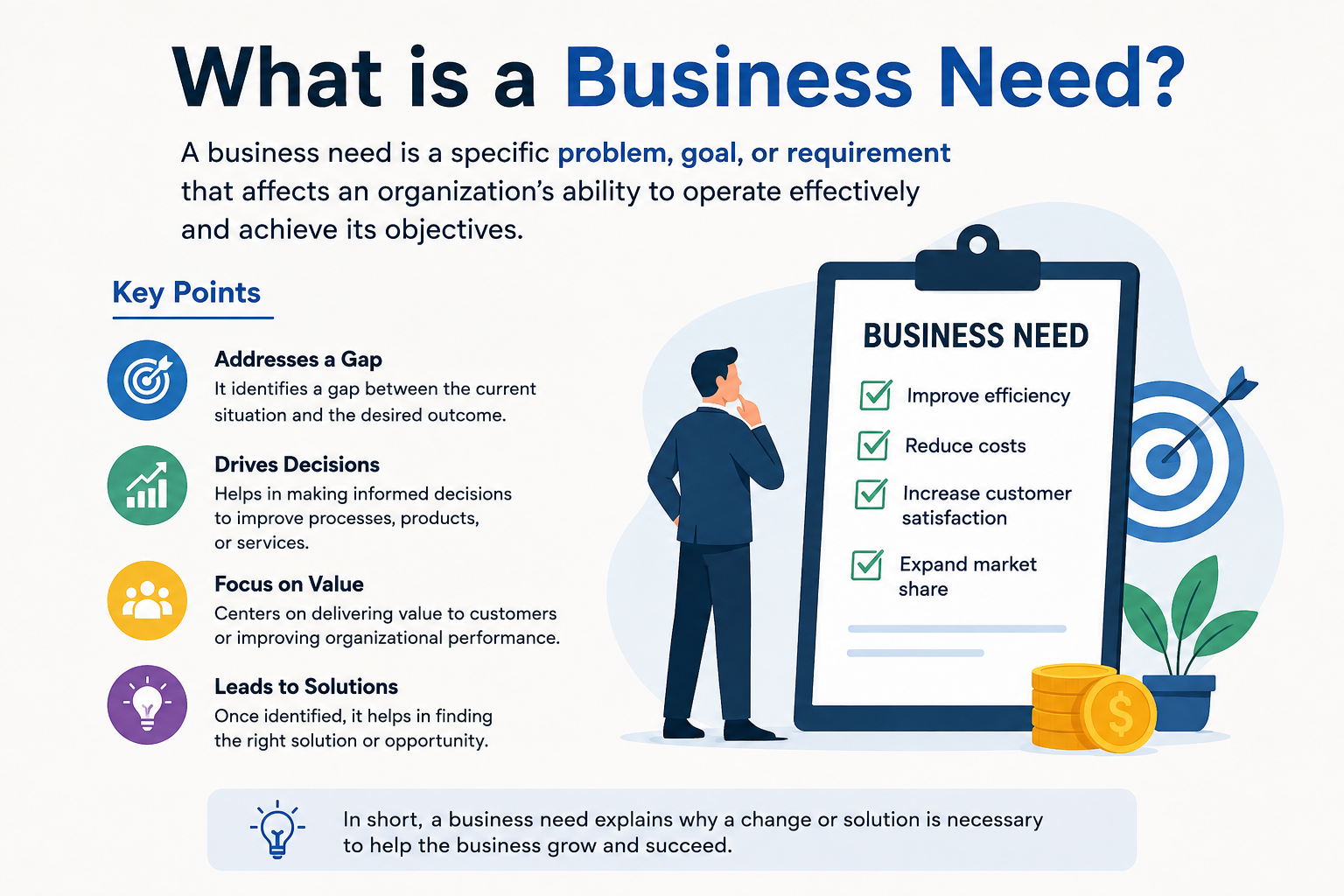
For those who wonder what is a business need, the basic definition is that it is a requirement that needs to be fulfilled by the company in order for it to realise its objectives and function successfully. These can pertain to clients, workers, technology, money, processes, or expansion. Understanding business needs will enable organisations to make wise decisions on how to allocate their resources.
What Is a Business Need?
The need is a definite requirement to be met to help a firm accomplish some objective or resolve some issue. The business need can occur on practically all organisational levels and range from customer support enhancement to cost reduction and the introduction of new technologies.
To give an example, let us consider a situation when a retail firm receives more orders than it can cope with through manual processing. The organisation would then have to look into some need for better order-management software. Nevertheless, the software itself does not constitute the business need, but the actual need is to have better order-processing and error-reduction mechanisms.
It is essential to make a distinction between business needs and their solutions because the latter tend to distract businesses from actually figuring out what they really need. Therefore, instead of the question of which software they should purchase, the managers should first ask about what they really want to solve.
Having figured out the need, one can start evaluating the available solutions.
Why Do Businesses Need Needs?
Knowledge of business needs helps organisations relate their day-to-day activities to their goals. Otherwise, the companies would waste their money, efforts and time on unimportant projects.
Let us consider an example of an organisation willing to enhance its website. The organisation may think that it should create an entirely new website. However, the research may reveal that the customers of this firm are mostly concerned with the checkout procedures rather than the website design as such. In this case, improving the checkout procedures will solve the problem much better.
Business needs help to establish priorities. Companies do not have unlimited funds, so they cannot solve all problems at once. Identification of the most important needs helps to prioritise problems.
Common Types of Business Needs
However, business needs differ from one organisation to another, though several need categories are common in various businesses.
The financial needs may include increasing profits, cutting costs, improving the cash flow process or gaining new funding sources.
The operational needs can include such areas as increasing the productivity level, decreasing delays, inventory management or enhancing the efficiency of the business processes.
The customer needs may include such items as customer satisfaction, a decrease in the number of complaints, an increase in the retention rate and an improvement in products/services provided.
The employee needs may be such things as training, communication, improving working conditions and getting appropriate equipment.
The technology needs can consist of updating the existing technologies, enhancing the cybersecurity, automating the routine tasks and introducing new digital capabilities.
Finally, the growth needs may include such factors as entry to new markets, development of new products, hiring more personnel or opening new business locations. Handled well, growth needs like these are central to how to make your business successful in the long run.
However, despite that the above-mentioned categories are different, they often affect each other.
Business Needs and Customer Needs Have Much in Common
To make its business prosper, a firm needs to understand the customers. Some customer needs may lead to the identification of crucial business needs.
When clients repeatedly complain about the slow delivery process of a certain company, the business may need to improve logistics, deal with various suppliers or develop another inventory approach.
The customer faces the problem, whereas the company has to discover how to solve it internally.
In this way, feedback from customers may become the key source of business intelligence. Such things as surveys, client reviews, requests for technical support, interviews and purchase data can be useful for identifying such information which cannot be revealed in the internal discussion.
Businesses need to stop making false assumptions about what the customers actually want. Gathering the information and analysing the behaviour of the customers can be helpful for the right decision-making.
How to Recognise a Business Need
The recognition of the real need starts with identification of the problem, opportunity or gap.
Firstly, one should ask why the company is unable to achieve its present goals. Do sales decrease? Do clients leave? Are employees wasting a lot of time completing some manual operations? Does the operation cost rise? Is there any competition?
The next step is gathering the information that can provide the insight into the situation.
If the satisfaction of clients becomes lower, then one should investigate customer complaints, response times, product quality, return rates and services. One should find the reason for the situation rather than try to resolve the first problem which arises.
Also, talking with employees will be very helpful, as they may face the inefficiency of operations in the company. In such a way, one will have all the necessary information to determine the problem.
Afterward, one has to define the need precisely.
Not only saying “We need better technology” but also saying “We need a faster order processing system to reduce the number of errors in manual input and delivery times” can be more effective for assessing possible solutions.
Differentiate Between a Business Need and a Business Solution
Confusion between a need and a solution happens often in business planning.
For instance, “We need a new customer relationship management system” may sound like a need for an organisation. However, what the organisation may really need is that all customer data is available in different systems and employees have difficulties accessing that information.
Even though a CRM system may ultimately prove to be a proper solution, it should not be chosen without understanding the problem first.
Such an approach allows organisations to look at other alternatives to solving the issue. An organisation may solve the problem by creating software, optimising processes, training employees, or applying various solutions altogether.
Business Needs Can Change Over Time
The needs of an organisation do not remain constant forever; as markets, technologies, consumers, and competition evolve, other needs can arise.
A small enterprise might first have the need to establish brand recognition and acquire its initial consumers. However, as the firm continues to grow, the need will no longer be focused on acquiring but rather on hiring employees, process automation, financial management, and retaining the consumer base.
This implies that companies must constantly reassess their needs as opposed to decisions they made many years ago.
For instance, when there is a small volume of business transactions, the need for an accounting process might not be much of a problem. However, as sales volumes increase, the process might prove to be less effective and cause more mistakes. Therefore, there is the need for better financial management solutions.
Use Data to Support Business Decisions
Decision-making based on assumptions as to the nature of a business need is often a poor choice. Data gives better support.
In accordance with the context, businesses might look into their sales figures, customer retention rate, web traffic, employee productivity, operational costs, stock balance, customer satisfaction rates, and other appropriate metrics.
If the business suspects that it loses sales because customers dislike the product, the sales data and customer feedback might show that in reality the customers enjoy the product but find it hard to buy due to a complicated ordering process.
This would be a new discovery and a completely different business need. The company will have to make the purchasing process easier rather than change the product.
Data alone doesn’t negate the need for human judgement but helps in making better-informed decisions.
Prioritise Business Needs
However, not all business needs need an immediate response. An organisation has to understand which problems are urgent and which are not.
One way of prioritising business needs is based on their possible consequences, urgency, cost and relevance to organisational strategy.
For example, there might be a vulnerability in the area of cybersecurity – this requires an immediate fix, as otherwise it might result in a data breach. Meanwhile, improving the office environment will be nice but not urgent.
Organisations may also look at the number of affected customers or employees and whether solving this problem will yield tangible benefits.
Prioritisation helps organisations not to spread their efforts thin.
Align Business Needs With Strategic Objectives
Business needs must be somehow linked with an organisational objective.
In case the organisation seeks to improve customer retention, the following needs may appear to be relevant: product quality, customer service, communication and loyalty programmes.
In case the objective is related to expansion across borders, there may be needs for market research, localisation, logistics, regulation and an international payment system.
The described approach will ensure that each individual project fits into the general strategy of the company.
Moreover, in such a situation it will be easy to understand whether the investment has been worthwhile or not.
Examples of Business Needs in Various Sectors
The restaurant may find a need to minimise food waste as it notices that a lot of food is being wasted. This need may require better forecasting, better inventory management, smaller portions or a change of menu.
The online store may find that its customers do not buy anything, as they abandon their shopping carts on a regular basis. This need may require improving the checkout process.
A manufacturing company may find that its production needs to be more efficient since the demand has increased but the output has stayed the same. This need may require automation, training of staff, upgrading equipment or process improvement.
A professional services company may have a need to enhance communication of its remote workers. This need may be addressed with better tools, processes or meetings.
The above cases prove that business requirements have strong associations with particular goals and issues. A franchise shows the same pattern: the Quick Trip franchise cost is a need any buyer must plan for upfront.
FAQ
How does a business need differ from a business goal?
A business need refers to a requirement or problem to be addressed by the firm, whereas a business goal refers to the outcome to be achieved. A need can usually explain why there is a necessity for a specific goal or project.
What are the ways in which a firm will know what its critical needs are?
A firm may look at information in terms of performance, customer, employee, financial, operational, and strategy. Needs would then be ranked based on urgency, importance, cost, and value.
Can technology trigger a business need?
Yes, changes in technology can lead to the emergence of new requirements for business firms. New security risks for a company or increased expectations of clients can be some reasons for a business need.
Does each business need a solution?
Not always. Each significant need has to be satisfied, but not necessarily through expensive solutions. Process improvements, training, communication, and efficient resource use can sometimes help deal with a need.
What is the importance of conducting regular reviews of the needs of businesses?
There are changes in the business environment. Regular reviews allow organisations to identify new challenges and opportunities and adapt to current strategic goals.
Conclusion
Understanding what is a business need will help businesses to think further than solving immediate challenges and concentrate on the needs that affect their performance in the long run. The need that arises may relate to the improvement of customer satisfaction, cost reduction, efficiency improvement, support of employees, implementation of technology or creation of development opportunities. Defining this need will allow managers to consider solution options in accordance with the business objectives.
The best-performing organisations do not solve the challenge as soon as it arises. They use information from customers, employees, analysis of performance, and strategic planning to determine what should be changed. Regular prioritisation and linking of business needs to objectives will allow better use of resources and creation of valuable solutions.