How to Grow Muscles and Lose Fat: A Practical Guide to Body Recomposition
For the vast majority of people who decide to begin their fitness regimen, there are two goals that become the focal point. Initially, attaining these objectives appears challenging since muscle development requires one to consume more food, whereas fat loss involves the consumption of less food. However, the combination of the two objectives is possible using a sound strategy.
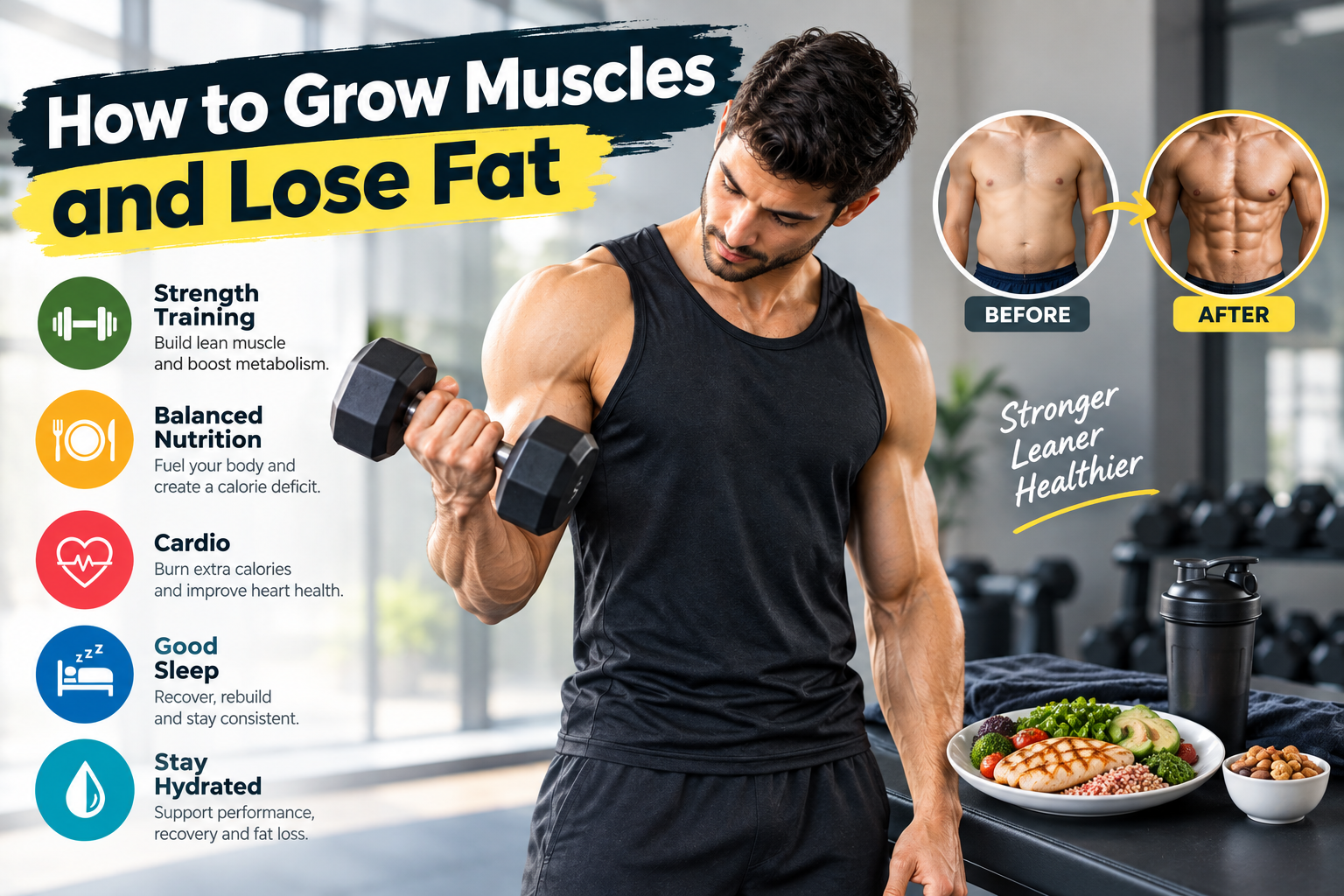
How to grow muscles and lose fat is best understood when the concept of a quick fix is left behind. The process of resistance exercise, proper protein intake, balanced nutrition, enough sleep, and consistency are all factors that come into play. Instead of hunting for some super diet or workout regimen, it is better to develop good habits.
Understanding Body Recomposition
Body recomposition involves enhancing muscle and fat proportions in the body. The idea here is not to concentrate solely on the number displayed on the scale but to aim at progressively increasing or maintaining lean muscle mass while decreasing excess body fat.
The strategy can be helpful for those individuals who have just started resistance training, those coming back to exercising after a long period of absence, and those who are changing nutrition and exercise routines.
Consider an individual who has just embarked on strength training along with improving his/her eating habits. Despite not seeing much change in the numbers on the scale, this person might find a difference in the way he/she looks in his/her clothes.
This is why body weight cannot be the only thing considered when judging progress.
Various measurements, strength gains, photos, clothing fit, and general level of physical fitness can give some additional information on progress.
Focus on Strength Training
Resistance training is perhaps the most crucial aspect of developing muscle tissue. The stimulation provided by exercise is necessary in order to encourage muscle adaptation.
A balanced strength program may incorporate exercises including squats, lunges, rows, presses, and deadlifts, among others, that are suitable to a person’s experience and capacity.
The program will differ depending on the level and objectives of a specific individual. A beginner will be advised to concentrate on learning how to execute exercises correctly and being consistent before advancing to other training programs.
Progressive overload is another key concept. Progressive overload refers to the gradual increase in the stimulus applied to the muscles over time. Progress can be made through greater resistance, more reps, improved form, and increased difficulty of training.
It is not necessary for all training sessions to feel like a challenge, but it is important that the body receive a proper stimulus and have sufficient time to recover from each session.
How to Grow Muscles and Lose Fat Through Nutrition
Nutrition is one factor that is taken into consideration when dealing with body composition. For a person to develop muscles and decrease fat in the body, they have to pay attention to calories as well as the types of food eaten.
This category of food is particularly vital since it provides proteins necessary for muscles to recover and grow. Egg, fish, chicken, lean meat, dairy products, beans, and tofu can be some of the proteins available for inclusion in one’s diet.
Intake of any food that contains lots of protein will ensure that one easily gets the amount needed and makes them full.
Carbohydrates are famous for supplying energy to work out and daily activities. Food such as oats, rice, potatoes, grains, and fruits should be included in one’s diet.
Healthy fats are equally crucial since there are some types of foods that provide them. Nuts, avocados, olive oil, and some fish species, among others, can be considered in one’s diet.
Completely restricting one food group is definitely not the ideal solution.
Establishing a Moderate Caloric Deficit
The process of losing body fat happens when the body uses more energy than the body consumes. The method used to achieve this state is typically referred to as a calorie deficit.
But an excessively aggressive caloric restriction is not always beneficial. Too little food makes it harder to train, increases feelings of hunger, and makes it harder to retain muscle and regularity.
For many people, the moderate route may be more feasible.
The amount of energy that can be used depends on the person, as his/her weight, age, interest level, and exercise regime play a role in figuring out how many calories we all need.
It’s better to overcome the lure of scarcity and concentrate on healthy eating and ingredient control as an alternative.
If an individual is uncertain about the amount of food that he/she needs to consume, he/she can get advice from a qualified nutritionist.
Eat Enough Protein
Protein intake becomes even more crucial in terms of improving body composition.
Muscles constantly undergo breakdown and repair processes, and sufficient intake of proteins will give the necessary raw materials for that, especially if accompanied by resistance exercises.
In place of eating all of the protein at once, many individuals have found it to be convenient to spread out their intake of protein throughout the entire day.
This would include having an egg or Greek yogurt for breakfast, chicken or beans for lunch, and fish, meat, or tofu for dinner.
Additionally, protein-containing snacks will prove to be helpful if it becomes possible within one’s general nutrition regimen.
Still, more proteins do not necessarily equal more benefits.
Do Not Neglect Cardio
While weightlifting is excellent for muscle development, doing things such as cardio makes you fitter and burns calories as well.
Taking walks, riding bikes, swimming, jogging, or any kind of cardio that you may like will help improve your heart and make you move around more.
The amount of cardio you should do depends on your objectives and recovery rate. An excessive amount of cardio in addition to inadequate diet and intense weight lifting may complicate recovery.
Anything contributes to something. Increased walking, stair climbing, and being physically active in general could help burn calories without making each activity a rigorous workout.
Resistance exercises combined with cardio will normally make a good regimen.
Let Your Muscles Take a Rest
The muscles don’t grow by repeating the same exercises all over again and again; they need some time to recuperate.
One of the most precious ways is through sleep when the body gets enough time to recuperate and keep its functions normal after the physical strain.
It is advisable for the majority of people to have some regularity in their sleeping patterns and get high-quality sleep regularly.
Also, the rest days are extremely important because stressing one group of muscles without giving enough time for rest results in a poor performance and exhaustion.
Thus, the right physical training program should include intensive training and recuperation periods.
Consistency Is Better Than Quick Fixes
Many people think that rapid success comes within only a couple of weeks, yet it is a mistake.
Muscle gain and fat loss are gradual processes that depend on a number of things, including your genetics, training background, diet, sleep, stress levels, etc.
It may happen that the process goes slowly. It does not mean that your efforts are fruitless.
For instance, you may improve your strength in the gym during several weeks, yet there will be no visible changes. Or you may have to observe changes in your measurements before noticing some weight change on the scale.
Small changes will add up over time.
Don’t ask yourself if you underwent big changes over a very short period of time but rather whether your training, eating, sleeping, and activities became more regular.
Monitoring Progress in More Ways Than One
Your weight is valuable data to know, but it’s not the only data point that matters.
If someone builds muscle while burning fat, there’s going to be minimal movement in total weight because they have two things happening simultaneously.
Tracking various factors like strength, physique measurements, photos, workout results, and fit of your clothes may be useful.
Maintaining a basic training diary may also prove helpful. Documenting exercises performed, number of reps, resistance used, and workout experience can help to see progress.
Consistent body metrics will need to be recorded in similar circumstances if you decide to include them. There are many reasons why your weight can fluctuate on a daily basis due to hydration, food, etc.
Analysis of long-term trends offers a better perspective.
Control Your Expectations of Where to Lose the Fat
The area from which the body starts losing fat is something that no one can fully control.
This is because the genes of the body play an important role in determining where the fat will be lost.
This also implies that the exercises done on one specific area of the body cannot assure you that fat will be lost from that particular area.
An instance where this happens is when doing a lot of abdominal exercises; you will be strengthening your abdominal muscles but not making the body lose fat from that particular area.
Stay Away From Extreme Diets and Workouts
Fitness business is filled with promises of quick transformations. Some diets will remove the fat from your body quickly, and others will help to build muscles within a couple of days.
Such techniques may be hard to keep up with and divert the attention from the basics.
There is no need to make things too complex. A good combination of strength training, healthy nutrition, enough protein, proper calorie consumption, rest, and physical activity in your everyday life is what you need.
Sometimes there is a place for supplements in the nutrition process, but they cannot be considered substitutes for healthy eating and working out.
Anyone who considers going through a strict diet regime or workout regime or taking any supplements should think about consulting a professional in this field first.
Sustain Your Routines
The most ideal fitness routine is one that can be realistically maintained.
If you don’t like running, you don’t have to design your whole routine according to running.
Resistance training can be modified according to the type of equipment at home if you like home workouts. If your time is not flexible enough, it would make sense to have smaller but regular workouts rather than a tough regime that you cannot follow.
It is the small habits that will reward you with a great gain.
Make sure to plan your meals, carry high protein snacks, exercise at a scheduled time, ensure you sleep well, and record your progress.
Your system should be simple and realistic, not some big change to your life.
FAQ
Is it possible to put on muscle while losing fat?
Yes, there are certain individuals who can increase muscle mass or maintain their existing muscle while lowering their body fat content, especially those who are just beginning to work out.
Importance of Protein in Muscle Growth
Protein helps in repairing and maintaining the muscles. Nonetheless, sufficient intake of protein needs to be coupled with resistance exercise and adequate energy.
Does cardio have to be done to lose body fat?
Cardio is one means of losing body fat; however, cardio can help improve your cardiovascular conditioning while burning more calories. Resistance exercise and proper physical activity can achieve the same objective.
Are there certain exercises that can reduce the fat in a particular part of the body?
There are no exercises that can guarantee reduction of fat in a certain part of the body since fat reduction is determined by an individual’s physiology, whereas particular exercises are capable of strengthening muscles of the worked part of the body.
How soon will you start seeing results?
This timeline depends upon individuals. Training experience, diet, genes, and sleep can affect progress made. The better thing would be to focus on developing habits instead of seeing results immediately.
Conclusion
When it comes to learning how to grow muscles and lose fat, balance is necessary, not an intense workout routine. The right nutrition, along with resistance exercises, gives the body a boost it needs to build muscles, as well as lose fat. Protein, constant motion, good night’s sleep, and other factors will all help.
The key takeaway from the above is that progress takes its time. Do not focus on a strict diet or a very hard workout routine; try to develop a habit that will work for you for many months and even years. Track different measurements of how you are doing, not only your weight, and change the process when necessary.