Understanding What Brands Are Considered Fast Fashion and Why It Matters
The fashion industry used to work on a season basis; however, nowadays fashion can emerge in the morning on the web page and be sold in the shop within a week. The acceleration in fashion is reflected in its consumption cycle and makes people more willing to try out something new and change their wardrobe. However, the way the fast fashion industry operates cannot be considered simple, as many processes are involved and should be studied by a contemporary consumer who looks for the quality.
Fast fashion appears to be an ideal choice for a young person shopping online or an office worker looking for some cheap garment. It is beautiful, affordable, and convenient. Nevertheless, the knowledge of how this type of fashion works is necessary because there are many processes involved, such as production speed, logistics chain, workers’ working conditions, waste, marketing, and the behavior of the consumer himself.
What is it that makes a fashion brand “fast”?
What brands are considered fast fashion? The first characteristic feature of fast fashion lies in its speed. Whereas conventional fashion firms have seasons based on spring, summer, autumn, and winter, fast-fashion firms always produce new collections following the trends.
It usually starts with trend research when brands pay attention to what goes on in fashion shows, on the Internet, on celebrities, street wear, etc. When a certain trend catches on, the firm starts developing products following this trend and producing them.
Another essential aspect is the price level since most fast fashion goods are cheap enough to be affordable for customers. They do not buy expensive items meant to last for many years but buy more often some cheaper pieces.
It creates a great circle since trends catch on, new products appear, prices are low enough, and people purchase more often.
What brands are considered fast fashion?
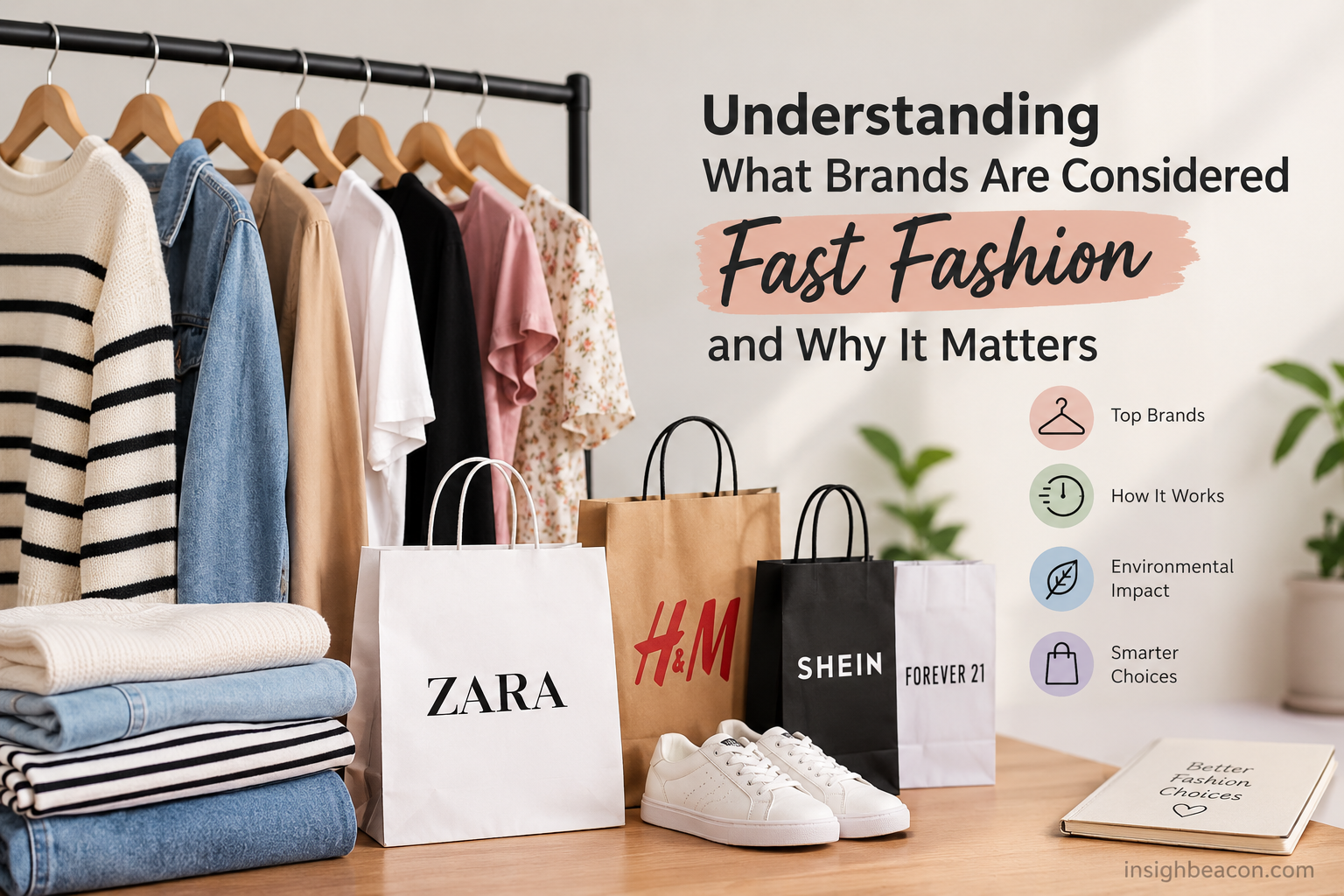
What brands are considered fast fashion? In discussions of fast fashion, there are some globally famous retailers that come to mind. One of the best-known examples of this phenomenon is Zara, with its quick product development and trendy business approach.
H&M is yet another well-known brand in this sphere. It operates all over the world and focuses on affordable prices and frequent collections.
Forever 21 can also be said to fit into this group due to its focus on cheap and trendy clothes. In the same way, Boohoo became well-known due to its vast online collection and quick product development.
SHEIN is a good example of a fully digital brand of this kind. Instead of focusing on physical stores, it uses a huge online platform based on data, social media trends, rapid product development, and frequent new additions.
Besides, Primark, Fashion Nova, and PrettyLittleThing are often mentioned when talking about fast fashion companies.
Nevertheless, sometimes it may not be that clear-cut. Fashion brands may change their business strategies, introduce sustainability programs, modify production process, and operate under different brands. Thus, it is better to consider fast fashion a business model than a list of companies.
How the Fast Fashion Business Model Functions
Consider a fashion trend emerging on social media, where thousands of people start to post outfits that include a specific color, shape, or design feature. A typical fashion business could study the trend and make it part of their upcoming collection.
The fast fashion business, however, could operate much quicker.
Its employees could spot the trendy styles, examine customer preferences, and design and manufacture them and then either put them for sale online or in stores. Thanks to digital technology, the process becomes even quicker since the companies can monitor which products have been clicked, searched, reviewed, and purchased.
The decisions about inventory could be based on customer behavior as well. When the product is performing well, its number could be increased. When it does not show much interest from customers, the businesses could focus on something else.
In this way, the responsive retail system is established. Clearly, there is an evident benefit—customers have more products to choose from, and businesses can act quickly to the demand. The only disadvantage would be that frequent production could stimulate overconsumption.
The Reasons Why Consumers Are Attracted to Fast Fashion
First of all, the cost factor should be considered.
It seems less risky to spend little money on fashionable clothes instead of buying expensive items or designer clothes. This is especially attractive for students and younger people who like to try themselves in different outfits.
Accessibility also plays a role.
Fast-fashion brands are known to have been operating from various places, whereas online-only brands can reach customers from all over the world via mobile applications and websites.
Moreover, there is an emotional component.
Fashion is associated with one’s identity. One may want to wear a different outfit depending on whether it is about going to college, a holiday, a trip, a party, and so on. With affordable trend-based clothes, one can do it more easily.
Social media reinforces this tendency.
With constant updates of one’s news feed with outfits shown in video clips or pictures, old clothes may become boring even though they still are wearable.
In the end, it turns into the novelty becoming a part of the product.
Social Media Role
Social media has revolutionized the interaction between fashion brands and consumers.
Social platforms enable the dissemination of trends throughout the globe in a matter of hours. Trends created by one creator can be emulated, adapted, analyzed, and shared by a wide range of people.
Social platforms can also enable brands to know more about the preferences of the consumers. Apart from depending only on market research, brands can analyze the responses to new trends.
This leads to the role of influencer marketing. By seeing their favorite creators wear certain products, consumers may view such products as desirable and relevant.
This sets up a positive feedback loop. Consumers react to trends, brands manufacture products around those trends, creators promote them, and the content produced triggers another wave of interest from consumers.
Under these conditions, fashion is not seasonal anymore but becomes continuous.
Environmental Issues Related to Fast Fashion
One of the most significant issues regarding the fashion system is related to its environmental effects.
Production of clothes consumes raw materials, water, energy, transport, packaging, and manufacturing resources. If clothes are manufactured fast and bought often, then the environmental impact may become bigger.
Waste in the form of textiles is also an issue. Clothes that are not used often will sooner or later be thrown away instead of being fixed, given away, or recycled.
Synthetic materials are problematic in their own right since a lot of such clothes contain materials from fossil fuels and take much time to decompose. In addition, when some synthetic materials are washed, tiny fibers may get into the wastewater.
Transportation is also an issue. Clothes go through a few stages until they reach customers: raw materials processing, production, storage, shipping, and distribution.
It should be mentioned that the impact of fashion on the environment is a complicated thing. It depends on many factors, such as the material of a garment, durability, manufacturing process, transport distance, washing process, and longevity.
Labor and Supply Chain Concerns
The other human element of fashion is just as significant.
Clothing manufacturing requires extensive global supply chains. Clothing might be produced in nations where labor expenses are lower, making it possible for them to keep their costs down.
This makes manufacturing economies viable. Yet, the problem with supply chains is that there may be problems regarding wages, work hours, working conditions, and worker rights.
There have been increasing pressures on major fashion businesses to increase their transparency and prove responsible sourcing. This includes contributions from consumers, regulators, media, and advocacy groups.
The message for consumers is that it is not necessary that all cheap clothing is unethical. Rather, it is about the fact that a price tag alone tells you very little about the process of making that item.
The knowledge of supply chains enables consumers to ask more intelligent questions.
Fast Fashion Compared to Sustainable Fashion
There is only one significant difference between fast fashion and sustainable fashion—priorities.
Generally speaking, fast fashion focuses on rapidity, cheapness, relevance, and a wide range of products. As for sustainable fashion, the priority here is put on durability, sustainable materials used, minimizing waste, ethical manufacturing processes, and long-lasting products.
Moreover, sustainable fashion does not necessarily imply buying expensive designer products. It can include buying fewer things, opting for durable clothes, fixing damaged clothes, buying second-hand clothes, and taking care of the clothes you currently have.
For instance, you might discover an old jacket in your wardrobe and find out that this jacket perfectly suits different outfits. In case a new trend has appeared on the Internet, there is no need to buy a new jacket since you already have one that suits perfectly.
Can Fast Fashion Brands Be More Sustainable?
There are certain changes happening in the sector, yet they are rather complex.
Many fashion brands have started discussing such aspects as recycled fibers, responsible sourcing, garment collections, environmentally friendly packing, and increased transparency of supply chains. In addition, some of them have begun investing in technology that is supposed to make their operations more environmentally friendly.
Yet, it is necessary to look at these statements in detail.
Just because a company starts producing clothes from recycled materials does not mean that the whole model of business becomes sustainable. Consumers have to take into consideration a variety of factors, such as the number of produced items, durability of garments, transparency of the supply chain, type of used materials, and waste management practices.
It is also worth noting that there is a huge difference between making products more sustainable and creating a new consumption model.
If people keep purchasing clothes in large amounts and disposing of them quickly, environmental load will stay high despite the improvement of each individual item.
The Problem With “Buy More, Wear Less”
The most fascinating aspect of the fashion narrative revolves around consumer expectations.
For example, prior generations did not mind spending money on good-quality clothes and wore them for years before repairing or replacing them.
Today’s shoppers have the luxury of buying low-cost items frequently due to the rapid changes in fashion trends.
The problem lies not in what one person buys but in the actions of millions of consumers.
When clothing is extremely cheap, the perceived value of such a product drops, and a tiny tear, stain, or shift in fashion trends could prompt someone to discard the clothing instead of mending it.
This is the concept of clothing longevity in a nutshell.
Longevity is the ability of clothes to stay functional for many years and become a better purchase compared to numerous cheap pieces of clothing.
What Consumers Can Do to Choose More Sustainably
Consumers are not required to stop buying affordable fashion altogether in order to start thinking sustainably.
It is enough just to take a moment to consider purchases and ask oneself whether the garment will be used frequently or whether it is just appealing because it is fashionable at the moment.
Another tip is checking the material from which the garment is made. Various fabrics have various qualities.
Learning to take proper care of clothes is also practical. It means using the recommended washing method, not washing too often, and storing garments properly.
Second-hand clothes are also an option. Thrift shops, resale websites, clothes swapping, and even family hand-me-downs can prolong the life of the garment and lower demand for new ones.
Above all, consumers should stop thinking about fashion in ideal terms. Even making sustainable decisions occasionally is significant. There is no need to make one’s entire wardrobe sustainable immediately.
Future of Fashion Retail
The future of fashion may well be a combination of technology, shifting consumer demands, and increasing concerns for sustainability.
Artificial intelligence, data analytics, automation, and online shopping will certainly accelerate trend prediction and product development even further. At the same time, consumers will continue to demand transparency regarding materials, manufacturing, and impact on the environment.
Resale is becoming another significant consideration. Clothing should no longer be considered a disposable commodity but rather a product that will have many owners throughout its lifespan.
Repair services, rentals, recycling systems, and made-to-order production may become other factors shaping the future of the industry.
Fashion is unlikely to cease evolving in the foreseeable future. It remains to be seen, however, whether all of that evolution will focus solely on the production of ever more products or it could become an opportunity to develop a system where fashion, access, and sustainability could coexist together.
Frequently Asked Questions
Is every low-cost fashion brand fast fashion?
Not necessarily. Being cheap is one of the characteristics of fast fashion but not a defining factor. Fast fashion includes a combination of inexpensive items, frequent changes in trends, quick releases, mass production, and agile logistics.
Why is fast fashion so attractive?
The fashion becomes popular due to its stylish designs, reasonable prices, and ability to easily keep up with trends. The development of social networks and e-commerce has made the fast fashion trend even stronger.
Is fast fashion always environmentally unfriendly?
Its environmental effect can be considerable when there are high volumes of production, a short life span of clothing, and high amounts of waste created. At the same time, the environmental impact of a particular item of a specific company may differ.
Is it possible for customers to consume fast fashion sustainably?
Customers can become responsible consumers through making thoughtful purchases, choosing clothes that are needed and which will be worn often, taking proper care of the clothes and looking for alternatives to purchase, such as second-hand clothes.
What should I pay attention to while evaluating a fashion brand?
Look beyond marketing hype. Evaluate the longevity of products, materials used, supply chain, manufacturing processes, possibilities for repair or resale, and whether the company is open about their policies towards the environment and labor.
Conclusion
When considering the issue of the brands that constitute fast fashion, we may raise a discussion regarding contemporary approaches to designing, producing, selling, and purchasing fashion clothing. It may be stated that although the brands involved in fast trend cycles enable people to wear fashionable clothes, the manner in which they operate may pose certain issues connected with waste production, resource management, and labor practices. This information will help us be better-informed consumers who are able to make responsible decisions when it comes to fashion purchases.
It should be noted that fashion will not necessarily become boring or costly as long as it becomes more responsible. The following small steps may be taken: conscious buying, extended use of clothing items, repairs of useful clothing items, and trying to look for second-hand clothing.