What Causes Hair Loss? 11 Common Reasons and When to Seek Help
Having a lot of hair strands on your pillow, brush, and shower drain might be very worrying, particularly if you don’t know what caused this phenomenon. We lose hair every day, but excessive hair loss may be due to a variety of reasons. Information on what causes hair loss will give you some ideas regarding possible reasons and let you decide whether you need professional help.
Hair loss may not be permanent and does not necessarily point to some major issue at hand. There could be genetic factors, hormones, illnesses, stress, diet, medicines, or even methods of taking care of your hair that could be causing hair loss. The problem is that the various causes may appear the same.
What Is Normal Hair Shedding?
One needs to remember the fact that the hair growth cycle itself implies the constant shedding of hair as the scalp forms new hairs and old ones rest and fall out. As mentioned by the American Academy of Dermatology, it is normal to shed about 50 to 100 hairs a day.
In addition, the number of shed hairs can differ from person to person depending on how often he or she washes or brushes the hair. People who wash their hair not often will have more loose hairs during one washing because of accumulated hair shedding within several days.
This problem tends to come into consideration more often when hair loss starts to become more significant, when the hair begins to look thin, when there is a patch where the hair is missing, or when the hairline starts to recede.
What Causes Hair Loss?
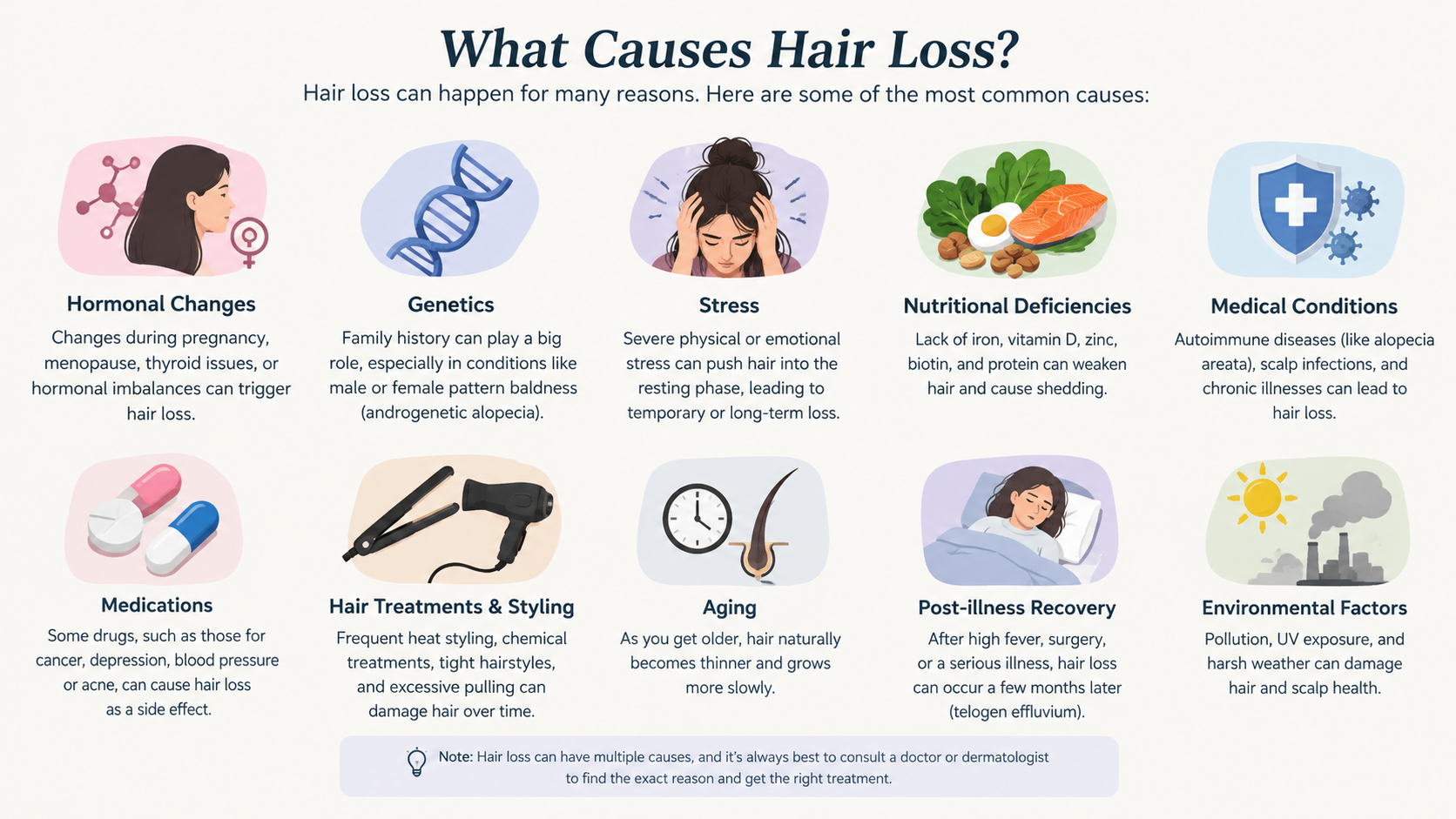
The reasons why hair is lost are very complicated, and there is no one reason for hair loss. Hair may be lost for genetic, temporary, or medical reasons or because the hair and scalp are not taken care of.
One of the commonest reasons for hair loss is genetics, or hereditary hair loss, also called androgenetic alopecia. Both men and women suffer from it, but in a different way. Men lose their hair due to the receding hairline or balding of the crown area, while women usually have wider hair parting or general hair thinning.
Hair loss due to other causes can come about quite quickly. Hair loss could occur a few months after suffering from some physical shock like an illness, high fever, surgery, delivery of a baby, weight loss, or something else. Hair loss like this could sometimes get better on its own as the body gets better.
There are so many potential reasons for hair loss, and this makes clues very helpful indeed.
Genetics and Inherited Hair Loss
Genetics can play a major role in determining hair density and the onset of thinning hair. If anyone close to you has had inherited hair loss problems before, then you have a higher chance of inheriting the same problem.
Hair loss that is caused by genetics tends to occur slowly rather than all of a sudden. Initially, it could be something as small as having a wider part in the hair, a smaller ponytail, a receding hairline, or more of the scalp becoming visible.
While there is no way to prevent genetic baldness, early detection can be useful. There are treatment methods that apply to certain cases, and detecting the condition early can create more chances of slowing down its development or preserving hair.
Changes in Hormone Levels Can Affect Hair Loss
Hormones regulate a variety of processes in the body, including the hair growth cycle. Therefore, any changes in hormone levels can result in either excessive shedding or a decrease in hair density.
Excessive shedding is observed by some women after pregnancy. It usually happens several months after childbirth and can get better with time. Menopausal hormone level changes can also have an impact on hair density and thinning.
There are certain hormonal issues that may be related to hair changes too. For example, hormonal problems such as thyroid disease can cause hair shedding. When hair shedding is accompanied by other symptoms of a hormonal disorder, it is recommended to undergo testing in order to determine if there is any need for that.
It should not be assumed that all hair fall is due to hormone issues. The healthcare practitioner would need to take into account a few contributing elements simultaneously.
Stress, Disease, and Significant Physical Changes
The body can react to a large amount of stress in the form of physiological or emotional stress in a way that causes changes in the hair-growth cycle. An example would be that a serious disease, fever, surgery, or weight loss could lead to visible shedding.
The shedding may not happen right away after the stressful event occurred. For example, in certain situations, it may take months before you start seeing the results, thus making it even harder for you to link the two occurrences. After resolving the triggering factor, the growth of hair will eventually get back to its normal state.
The body can react to emotional stress too; however, it is vital to understand that there is a difference between the presence of stress and being a confirmed reason for hair loss.
Nutritional Problems and Restrictive Diet
The hair follicles need nutrients to help them grow. In some cases, having a low intake of nutrients like iron and protein can cause hair loss. Having an inadequate number of calories can also result in hair loss.
Having restrictive diets, fast weight loss plans, and poor appetite can put one at risk of nutritional issues. However, it is not advisable to take nutritional supplements without knowing if there is a deficiency.
In some instances, consuming excesses of nutrients can be dangerous. According to the American Academy of Dermatology, having too much of supplements such as selenium and vitamins A and E is associated with hair loss.
Having a balanced diet rich in protein and other nutrient-filled foods can be an ideal place to start.
Hairstyles and Hairstyling Practices
Sometimes, hair styling and the type of hairstyle can be one of the factors that causes hair loss. Hair styling practices such as tight ponytails, tight buns, braiding, cornrowing, and similar styles can result in traction alopecia.
The development of traction alopecia can start from the hairline and other parts where hair is repeatedly being tugged. In case there is a continuous strain, the hair follicles might suffer irreversible damage.
Hair can be made weaker by excessive heat and/or rough treatment. Use of excessive heat and pressure on the hair can cause weakness and thinning of hair.
Less tight hairstyles, gentle treatment of wet hair, and use of minimal heat and less pressure can be helpful in this regard.
Alopecia Areata and Autoimmune Reasons
This condition is referred to as alopecia areata; it is caused by the immune system targeting hair follicles. The condition usually presents itself in the form of patches of hair loss. These patches have a circular or oval shape.
While hereditary hair thinning takes place gradually, alopecia areata can happen rather abruptly. People with alopecia areata may get one or multiple patches of hair loss.
This condition may appear at any point in life, and if there is a history of this or some other immune disorder within a family, chances are higher. However, alopecia areata does not indicate that the hair follicles got permanently damaged.
It is possible to reverse the process with the help of a specialist.
Conditions and Infections of the Scalp
Sometimes scalp problems can be responsible for causing hair loss. Fungal infections like that of scalp ringworm can result in hair loss, especially when associated with scalping or any other change in the scalp.
There are other issues concerning the scalp that can lead to inflammation, itchiness, scaling, redness, or hair shedding temporarily. For instance, psoriasis can affect the scalp and might lead to hair loss.
When hair loss is accompanied by a lot of itching, pain, redness, scaling, sores, swelling, or discharge, it becomes imperative to check out on the scalp because the issue is not just genetic thinning of hair.
Medications and Health Issues
The use of particular medications or health issues may cause hair loss. There is hair loss during certain cancer therapies, but there are also health conditions, thyroid conditions, autoimmune diseases, and many other factors that may cause hair loss.
However, this does not mean that you should discontinue taking the medication if you think it is causing your hair to fall out because stopping any prescribed medication without consultation may be dangerous for you.
Through an examination, it will be easier to identify if there is any connection between the time of the hair loss and either the medication, illness, hormonal changes, dietary problem, or any other reason.
Indications That Your Hair Loss Is Something To Be Concerned About
Not all fallen strands need to be taken as signs of trouble. However, some things can be quite telling.
Professional help might be in order if you experience any of the following: rapidly growing bald spot, hair thinning, widening part, receding hairline, excessive shedding of hair strands, or hair loss from sites other than your scalp.
Some symptoms in relation to the scalp can also point toward something going wrong with your head of hair. They include burning, severe itching, soreness, flaking, redness, swelling, the presence of sores, or discharge accompanying hair loss.
The same goes for cases of persistent hair loss, hair loss that gets worse, hair loss that makes you depressed, or unexplained hair loss. Knowing the cause is important for choosing a course of treatment.
Diagnosis of Hair Loss
There is no diagnostic test that could account for all types of hair loss. In the first place, a dermatologist will need to ask about the onset of hair loss, its progression rate, recent illnesses, drugs being taken, diet, family history, hair styles, and other related information.
Next, the scalp and the hair will be examined for patterns that may reveal what the underlying problem is. Depending on the results, a healthcare provider may consider blood tests or even a biopsy in some cases to see whether there is some medical condition, deficiency, hormonal imbalance, or infection.
One of the reasons why finding out the cause may be more helpful than buying hair-growth products is that hair loss types are different and require different treatments. Not all hair-growth products are effective for every kind of hair loss.
Hair Growth Solutions
Though there are hair falls that cannot be prevented, one could always avoid any unwanted damage to their hair by taking proper care of their hair and keeping themselves healthy.
Soft methods of hair care should be followed, pulling hairstyles should be avoided, and over-heating of the hair should be minimized. Take a balanced diet containing protein, and refrain from under-eating. In case you are thinking of taking any hair growth supplements, consult your healthcare provider first, especially when you do not know whether you are deficient or not.
If you are suffering from hair loss, try to find out the cause behind it instead of trying out all possible hair growth products simultaneously. A dermatologist will tell you whether your hair can grow without treatment, what kind of treatment should be used, and what hair loss form you have.
FAQ
Is hair loss a day-to-day thing?
Hair loss is normal as the body sheds old hairs on a daily basis through a natural hair growth process. According to the American Academy of Dermatology, losing 50 to 100 hairs each day is perfectly fine. Losing more hair and experiencing bald spots is another case and needs to be evaluated.
Does stress cause hair loss?
Physical or mental stress may cause hair shedding in some cases, but this is not always the cause. There may be other underlying causes as well.
Does hair regrow when there is hair loss?
It will depend on the reasons behind it. There are some types of hair loss that may be reversed after resolving their triggers, while others may not be. The earlier you diagnose their reasons, the better it is to treat the problem.
Does having tight hairstyles lead to permanent hair loss?
The practice of maintaining hairstyles that cause tension and pulling on your hair for a prolonged period of time may lead to traction alopecia. Hair loss that arises from this condition is usually permanent if not corrected.
Should I see a dermatologist for hair loss?
You should consider visiting a dermatologist if you are experiencing hair loss that is sudden, rapid, patchy, persistent, or along with scalp problems.
Conclusion
What causes hair loss is an essential topic since hair loss can be caused by various reasons that range from natural processes to health issues, dietary issues, hormonal imbalance, immune system issues, and constant strain on the hair. The process itself may give some clues, but not all of them will help to determine the cause of hair loss.
Instead of using one hair care product, you should look out for signs of hair loss and seek professional help in case of persistent or unusual hair loss. After finding out what causes hair loss, you will be able to choose the right treatment and hair care routine.