What Are the Components of Health, and Why Do They Matter?
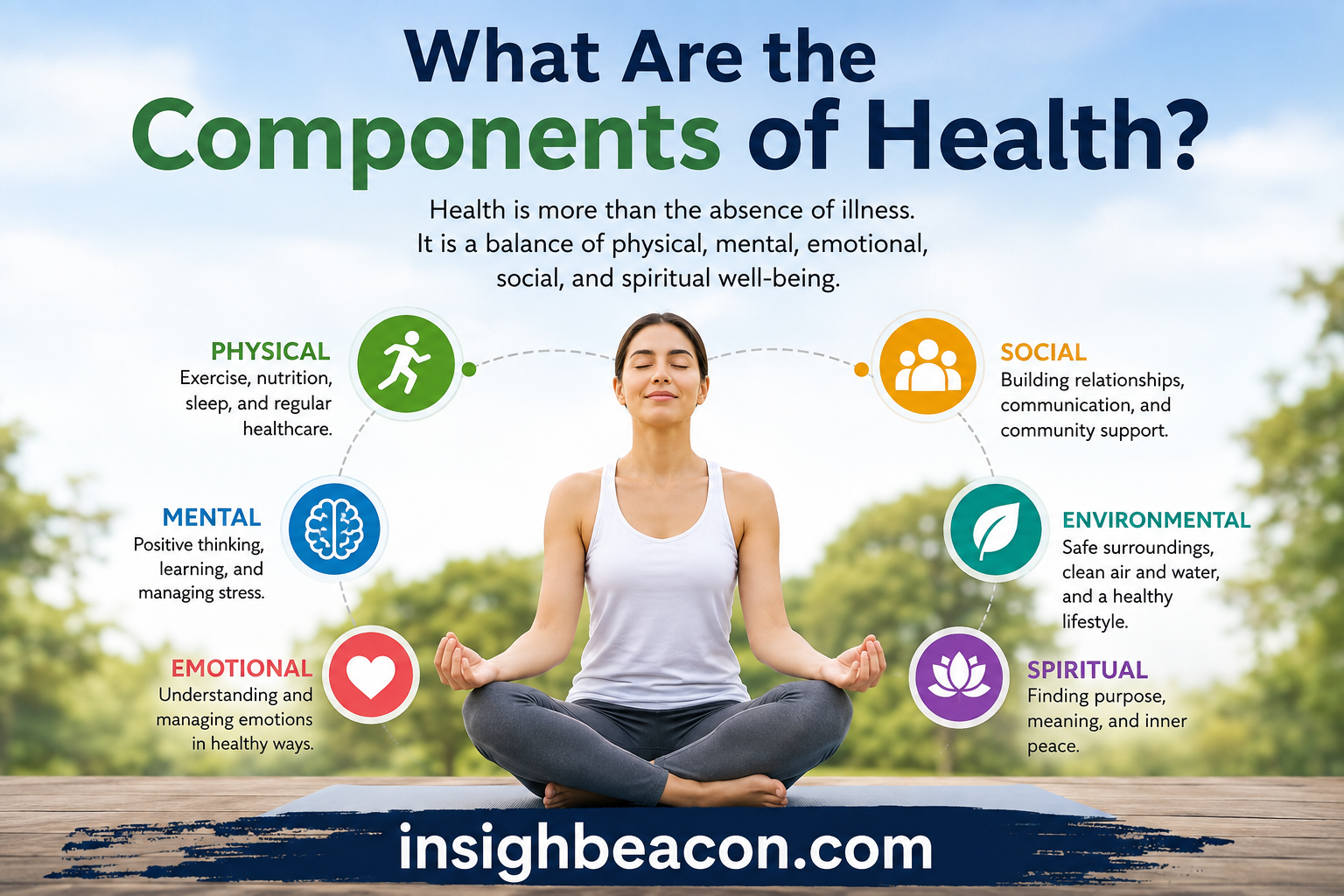
What are the components of health? Being healthy goes beyond being free from diseases. It involves waking up full of energy, ready to learn and earn a living, being composed in handling pressure, engaging in quality relationships, and making decisions that are good for your health. All these are related to various dimensions of health. Knowing these helps one understand what it means to be healthy and makes health appear simpler. Unlike when only one area is considered, this holistic view shows how our physical state, mind, feelings, social connections, environment, and lifestyle affect each other in ways that we might not notice in our daily activities.
An individual may have a good physical life but be emotional while another person may have a sound mind but neglect physical aspects. This is the reason why balancing health is very important. Ignoring one aspect affects other dimensions indirectly. Understanding the dimensions of health provides an easy way for individuals to identify their strengths and areas requiring improvement.
Understanding Health as a Complete Picture
The concept of health is defined as a state of well-being as opposed to the lack of disease. It brings about a shift in perception of how decisions in everyday life are viewed. Restful sleep, discussing problems with someone, eating healthy food, keeping friends, and living in a secure place are all part of one’s well-being. Seeing health this way is the first step in learning how to know if you’re healthy.
The concept of health can be compared to a group. All members have distinct roles, but the group works towards a common purpose. In the same way, aspects such as physical, mental, emotional, social, environmental, and many others form health.
The concept is quite useful considering that individuals have distinct requirements at various stages in life. Health requirements of a student may not match those of a working adult and vice versa. No formula for perfect health exists.
The Physical Dimension of Health
Physical health is likely to be the dimension that people are most used to considering. It implies the functioning of the body and the ability to provide proper physical care.
Physical activity, nutrition, enough sleep, drinking water, proper hygiene, and preventive medicine are factors that can improve physical health. Physical well-being also includes the monitoring of bodily changes instead of ignoring certain symptoms. That is why it helps to know how much sleep do you need each night.
For instance, one can take a case of an individual who spends a lot of time sitting while studying and working. He or she may not see the consequences right away, but in time, lack of physical activity will lead to tiredness, limited mobility or unfitness. Thus, adding simple movements can be a solution.
One should note that physical health does not imply any drastic measures. Such things as walking, stretching, playing sports, sufficient rest, and a balanced diet can be helpful choices.
The main point in regard to physical well-being is regularity. Small habits are easier to perform than huge steps that turn out to be too tiring.
The Mental Dimension of Health
What are the components of health? Mental health impacts the way people think, learn, concentrate, solve various problems, and perceive their daily experience. The mental state also influences the ability to make decisions and view oneself and the surrounding environment in the right way.
As an illustration of the importance of mental well-being, one may use the example of a student preparing for several tests at once. The student may be physically healthy, but he or she will have difficulties in focusing if there is constant stress. To organize tasks, taking appropriate rests, sleeping well, and communicating with a trusted person can be helpful.
The point is that mental well-being does not mean having only pleasant feelings. Such human emotions as stress, disappointment, frustration, and worry are natural ones. One should learn to cope with challenges and find ways to receive additional help.
Various activities like reading books, creative pursuits, outdoor trips, learning something new, and having a reasonable schedule can improve one’s mental well-being.
The Emotional Aspect of Health
Being emotionally healthy means being able to identify emotions, understand them, and express them appropriately. Our emotions affect our behavior, relationships, motivation, and everyday decisions.
One who understands his emotions may be able to realize when he is overwhelmed, angry, frustrated, or thrilled. In case he is upset and stressed, he can stop and think about his needs.
So, after receiving some disappointing information, one may want to withdraw himself from everything right away. He can give himself some time to get through this feeling and talk to a trusted friend or relative.
In other words, being emotionally healthy does not mean avoiding negative feelings or blocking them. This means gaining awareness of them and finding productive ways to cope with them.
Journaling, creativity, conversation, relaxation, and healthy routines may help one become emotionally healthy. In case of persistent or overwhelming emotions, talking to a trusted adult or professional may be beneficial.
The Social Aspects of Health
People are naturally social beings. Social health implies creating respectful relationships, communicating, establishing boundaries, and feeling a part of a community.
Having lots of friends is not a feature of good social health. One may have just a few really supportive relationships, which mean much more than dozens of shallow ones.
For example, take a look at a teenager entering a new school. He may feel lost and uncomfortable because of the new surroundings at first. Entering the school clubs and other groups and getting into conversation may help him adjust and find friends.
Healthy relationships always imply respect and communication. People should be able to express their thoughts and listen to other people’s opinions as well.
Sometimes social well-being can also mean realizing that the relationship is toxic. Establishing healthy boundaries and seeking support when needed are important steps towards self-care.
The Environmental Dimension of Health
In many cases, the surroundings can have an effect on us without our realization. The topic of environmental health deals with such concepts as clean water, air, sanitation, safe housing, proper working/educational environment, and lack of pollutants. When these basics fail, they become some of the most common public health problems.
A healthy environment makes people follow the healthy way of living. Safe outdoor spaces, clean facilities, healthy food, and reliable healthcare facilities influence our everyday decisions.
Imagine that there are two neighborhoods: one is well equipped, has safe walking paths, clean public spaces, and access to facilities; the other one is full of pollution and does not have any amenities. In this case, even if people are aware of healthy lifestyles, they may have less opportunity to follow them.
It proves the fact that health should be viewed not only from the point of view of individuals’ decisions. In addition, communities, educational institutions, governmental bodies, families, and different organizations also create circumstances for maintaining the good health of their members.
Easy ways to do it are maintaining the cleanliness of the surroundings, reducing waste, and conserving resources.
The Spiritual Dimension of Health
There are different approaches to the definition of spiritual health. It can be associated with values, personal purpose, reflection, connection, or meaning.
Sometimes spirituality is associated with religion; however, for many people it is related to nature, personal principles and beliefs, meditations, gratefulness, and finding meaning through relationships and service to others.
The essence of the notion is not connected with the certain type of belief. The key thing about spiritual well-being is the ability to understand personal values and find meaning in everyday life.
It allows making decisions based on one’s own principles that give additional perspective during difficult situations.
Reflection can be rather easy—spending time in silence thinking about one’s goals, expressing feelings in writing, helping someone, or spending some time in nature.
The Intellectual Aspect of Health
Intellectual health is the state of being curious, eager to learn, creative, reasonable, and open-minded.
Learning does not end once we graduate from school. Reading a great book, mastering a foreign language, experimenting with new technologies, solving different puzzles, conducting research, and acquiring new skills can entertain the mind.
Imagine a person who begins studying photography simply due to curiosity. In the beginning, he may have very little knowledge regarding light and composition. Through experiments, problem-solving, and creative development, he progresses.
That process supports intellectual growth.
Intellectual well-being also includes evaluating information carefully. In an age where people encounter enormous amounts of online content, the ability to question sources, identify misleading claims, and think critically is increasingly valuable.
The Occupational Dimension of Health
Working is an important activity that occupies most of adults’ days, so occupational health and well-being become quite significant. It means achieving a proper balance between duties, working environment, values, and overall life.
Having a successful job allows one to find meaning, stability, social contacts, and professional development opportunities. However, excessive stress or an inappropriate working environment negatively impacts the rest of life spheres.
School students can also find relevance of this topic in their lives through academic and occupational preparation. Organizing of activities, planning of time, teamwork, and skill building become useful to achieve proper working experience in the future.
Occupational well-being does not imply having a perfect occupation in the future. The key is setting realistic expectations and balancing of duties.
Connections Between the Various Aspects
The core message is that all aspects of health are interconnected.
Poor sleep can lead to a lack of focus. Lack of focus can harm performance in education. Challenges in education can cause stress, which in its turn can influence relationships and the urge to engage in physical activity.
All of these connections also have positive influences as well.
Physical activity on a regular basis can improve energy levels. Higher energy levels can help in engaging in social activities. Positive social interactions will improve the mood, and it will promote healthy behaviors.
The interconnection of these areas explains the complexity of simply addressing one aspect in order to address the overall issue.
A holistic approach begins with observation and awareness. Rather than thinking about how something went wrong, it can be more effective to consider which aspects need improvement.
The change in perspective can greatly simplify the process of dealing with health.
Striking a Balance in Achieving Wellness
There is no need to alter all of your lifestyle factors for improved wellness in one day. Attempting to make numerous changes simultaneously will make it difficult to create any sort of routine.
Take up one or two small, achievable tasks. For instance, a physically inactive person may just begin walking a bit. A second individual can begin sleeping on a more regulated schedule. The third individual, burdened by academics, may just make an easy study timetable.
It all depends on improvement rather than perfection.
It can also help to review different areas periodically:
Physical: Am I getting enough rest and movement?
Mental: Am I giving myself time to relax and concentrate?
Emotional: Can I recognize and express my feelings appropriately?
Social: Do I have supportive and respectful relationships?
Environmental: Is my everyday environment safe and healthy?
Spiritual: Do my actions reflect my values and sense of purpose?
Intellectual: Am I continuing to learn and stay curious?
Occupational: Are my responsibilities manageable and meaningful?
These questions are not a medical assessment. They are simply useful prompts for thinking about everyday well-being.
Common Misconceptions About Health
The first common misconception about health is the competitive view. Comparing our diet, physical condition, appearance, level of energy, and lifestyle to other people can be very stressful since everybody is unique.
Secondly, many of us believe that health results should come instantly. Being healthy means being consistent, which means that we cannot undo our previous efforts in one day and we cannot fix things by making one positive change.
Sometimes people concentrate only on their physical health, ignoring their emotional or social well-being. Some of us strive to be productive all the time, not leaving space for rest.
A more correct understanding of health is viewing it as a balance. Rest does not mean laziness, and requesting help does not mean weakness.
Simple Daily Practices That Enhance Your Overall Wellbeing
Good health comes from simple practices that you carry out daily rather than complicated rituals.
Sleeping for the recommended amount of hours makes you healthier physically and mentally. A balanced and diverse diet supplies your body with all necessary nutrients. Being physically active keeps you fit and energized. Contacting those who support you increases your social well-being.
Sometimes it is nice to take a break from being surrounded by the constant buzz of technology. A walk, a book, some time with your family members, organizing your workspace, and doing something interesting are ways to relax your brain.
Hydration, cleanliness, safety, responsibility, and healthcare practices are realistic components of your daily well-being.
The key point is developing a habit that will be realizable for you. The easier the better.
Frequently Asked Questions
Why is understanding different areas of health important?
Understanding different areas helps people recognize that well-being involves more than physical condition. Mental, emotional, social, environmental, intellectual, spiritual, and occupational factors can also influence everyday life.
Can one area of health affect another?
Yes. The different areas are closely connected. For example, ongoing stress can influence sleep and concentration, while positive social connections may support emotional well-being.
How can someone improve overall well-being?
Start with small, realistic changes. Improving sleep, eating a varied diet, moving regularly, maintaining supportive relationships, managing responsibilities, and making time for relaxation are useful starting points.
Is health only about preventing illness?
No. Preventing illness is important, but health also includes functioning well, maintaining relationships, managing emotions, learning, finding purpose, and creating supportive living conditions.
How often should someone review their health habits?
There is no universal schedule. A person can periodically reflect on their routines and notice whether something has changed or whether one area needs more attention. If a concern is persistent or serious, professional guidance can be appropriate.
Conclusion
When we know what are the components of health, it becomes evident that well-being is an integrated process of development rather than a single endpoint. Strength and physical fitness are important aspects of health, yet such factors as emotional stability, rational thought, relationships, engaging activities, values, education, and environment play their part in this process as well, contributing something positive.
A healthier lifestyle does not mean striving for perfection and making drastic changes. Rather, it involves observing our current state and implementing certain actions in order to move forward step by step. Sometimes we find it difficult and other times easier to make progress towards health, but the point is to form habits and relations that will help us be healthier in the long term.